Monday, 11 January 2016

FYP 2 Week 14 : Presentation


INTRODUCTION

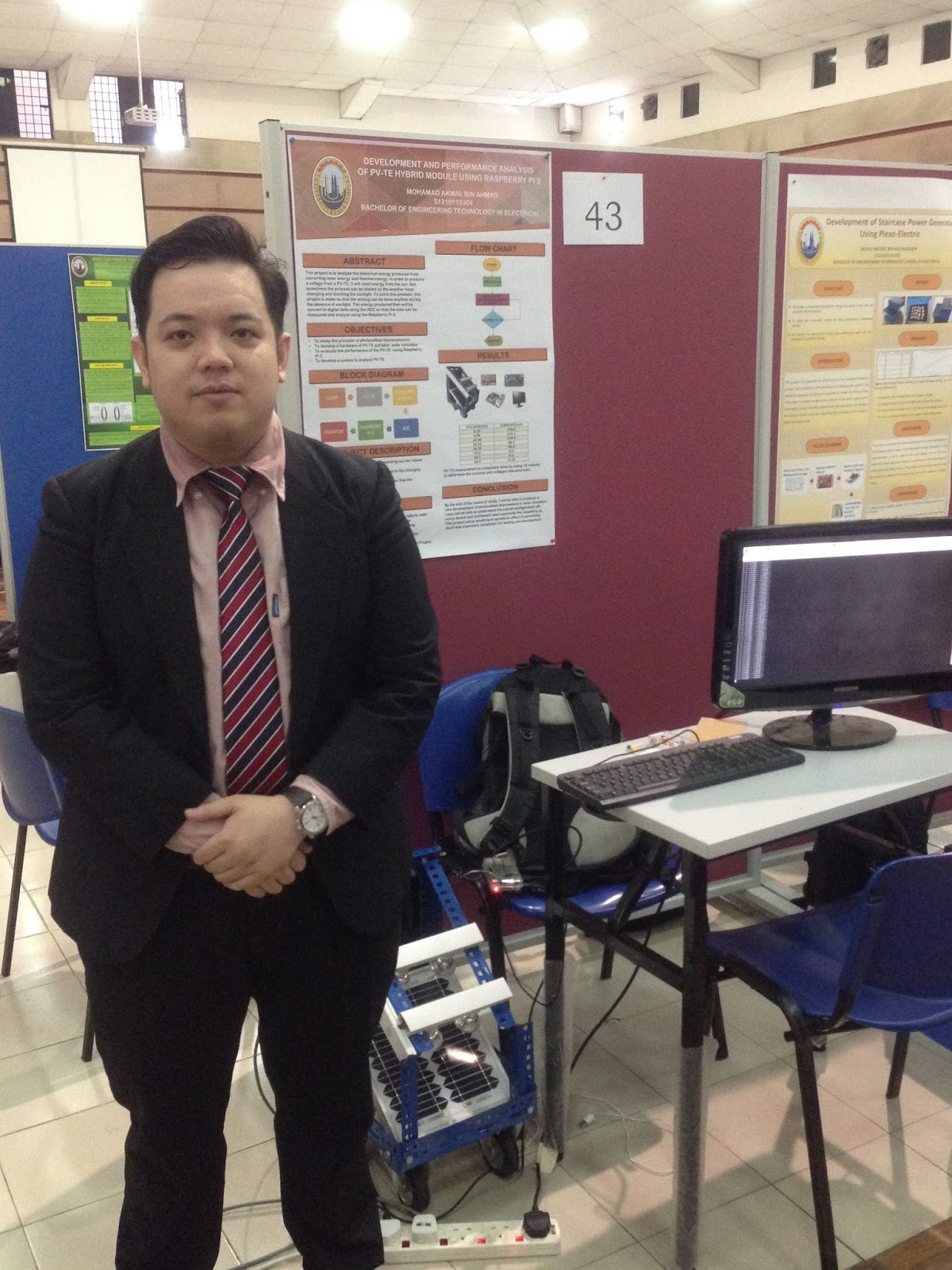
During presentation the development and analysis performance of PV-TE by using raspberry pi is presented to the accessors. Everything working will as expected base on the plan. During the Presentation day all part and connection was explain to the accessors in detailed to make them understanding about my project. All result show as proof that this project done successfully as planning and expected.


Wednesday, 23 December 2015

FYP 2 Week 14 : Poster for presentation

OBJECTIVE:
To finish the poster for the presentation for A1 size

METHOD
Using Microsoft Office Publisher to design the poster 

RESULT
Poster done base on the requirement need from the university


Monday, 14 December 2015

FYP 2 Week 13 : Work plan and total costing

Work Plan

The time frame allocated for this research study is 12 months. It started in January 2015 and is projected to be completed in January 2013. The Gantt chart for the project and its milestone are shown in table 5. Practically, the performance of electrical properties that will produce from module to Raspberry Pi. So the knowledge about Raspberry Pi software should be taken a long period to be done especially since we need to write in phyton language. Other than that, the difficulty that been faced is the connection between software and hardware. If the connection is not match for each other in case there is a failure in hardware or software the output as to monitor performance PV-TE also fails, by then the objectives will not be achieved. To solve these kind of problems it should be referred to professional that familiar with the Raspberry Pi software and also do troubleshoot by correcting the failure parts or system. This data is then analyzed, with many simplifying assumption applied. Besides produce software, prototype of PV-TE hybrid system hardware will be built to enables the community to visualize the impact and application of the proposed methods in determining the best solution in PV-TE hybrid system design with respect to reliability and cost.


Methodology is a needed process in order to achieve the project objectives. In other terms, it is used to develop the project itself. In this project, there have been several main components are used such as the Raspberry Pi, solar panel and thermal plate. All the main components is combine as a one system, Photovoltaic Thermoelectric hybrid module using Raspberry Pi 2.


FYP 2 Week 12 : Results & analysis

This project required hardware and software combination. For the software, raspbian os is used. Next, the program was written using the terminal txt on the Raspberry. The testing process cover both software and hardware to make the troubleshooting process easier to be made.

   The final testing is carried out to determine whether the system is running accordingly to the requirement or not. Later, some tuning process is made to make sure the system give the best result. The testing process covered the process of the whole system.


Software Result


Collect the data from the software, the results are recorded as below. The values of current and voltage are different by varying the variable resistor 1KΩ. The data are logged every seconds


Theoretically, PV cells can be modeled as a current source in parallel with a diode. In the absent of light to generate any current, the PV cell will behaves like a diode. As the intensity of incident light increases, current is generated by the PV cell, as illustrated in figure below. The objective of this experiment is been achieved which is to estimate the IV curve characteristic of PV module.
FYP 2 Week 11 : Full Assembling And Full Image Of Product

OBJECTIVE:
To assemble all component perfectly as the product is ready to use.
To assemble part and complete the wiring in the system.

METHOD
Finalize assemble the equipment by fitted every component and also wiring in the system

RESULT
The development of PV-TE hybrid module by using Raspberry Pi.


The full assemble project.

Because of the porting of the display is failed because I'm not that good with python language, I decided to use an easy code that seem to working.


FYP 2 Week 10 : Deciding on the result display

OBJECTIVE : To decide on how the result are showing


METHOD : Asking help from fellow forummer on raspberrypi.org and lowyat.net, on installing a 3rd party software. Meeting with Sir Zaki to decide on which display to choose.


RESULT : Display to use decided


CONCLUSION : From the meeting with Sir Zaki, I'm able to understand more on what to expect on the results.


FYP 2 Week 9 : Connect all part

OBJECTIVE : To connect and see if all part are in good condition


METHOD : Connecting the hybrid module to the charging circuit.


RESULT : The charging circuit can supply to a load


CONCLUSION :


FYP 2 Week 8 cont. building charging circuit

OBJECTIVE : To develop charging circuit. Continue task from last week.


METHOD : Building according to schematic diagram.


11)    Acid liquid is been prepared in container to immerse the PCB board. Immersed the circuit about 7 to 8 minutes to produce the line as constructed before for current conductor. Then the PCB is exposed to UV.


22)    Soldering process


33)    Connection to Raspberry Pi. Keyboard, mouse, hdmi and power are connected to the raspberry pi. The PV-TE hardware are then connected to the gpio ports using the Adafruit ADC.


FYP 2 Week 7 : Start doing charging circuit

OBJECTIVE : Developing a charging circuit.


METHOD : Prepared the component and the schematic diagram.


RESULT : Charging circuit progress


CONCLUSION : By having this circuit, we can stored the energy we get to a battery.


FYP 2 Week 6 : Deciding new circuit

OBJECTIVE : To find solution so that the output is stable and can be use as a load supply.


METHOD : Do a research on charging circuit. Deciding on components to buy. 


RESULT : Found soft copy on various website.


CONCLUSION : Component decided.

FYP 2 Week 5 : Testing the hardware

OBJECTIVE : To make sure everything works.


METHOD : By switching on the lamp, and measure on the module if there's any measurement.


RESULT : Multimeter are showing some measurement.


CONCLUSION : The module are still working.


.

Monday, 28 September 2015

FYP 2 Week 4 : Booting the Raspberry Pi

OBJECTIVE : To start setting the Raspberry Pi.


METHOD : Connected to 5v power, monitor, mouse and keyboard.


RESULT : Raspberry Pi 2 booted with Raspbian OS.


CONCLUSION : The raspberry pi are functioning properly.

The first time booting the Noobs OS, the data corrupted. Need to reboot again this time using the Rasbian OS.

Monday, 21 September 2015

FYP 2 Week 3 : Raspberry Pi research

OBJECTIVE : To understand more about the hardware and how to use Raspberry Pi.


METHOD : Reading the "Raspberry Pi for dummies" book, join forum and discussion on raspberrypi.org and watching related videos on youtube.


RESULT : What os to use is decided. Purchased a 2GB micro sd card to use together with the Raspberry Pi, to boot into Raspbian System.


CONCLUSION : By doing this research, I have understand much more about Raspberry Pi.


Monday, 14 September 2015

FYP 2 Week 2 : Meeting with supervisor to show list of hardware

OBJECTIVE:
1) To show the list hardware that need to buy for further process
2) To discuss the material need to use in the project


METHOD:
1) show all hardware listing to supervisor that need in your FYP project.
2) show the specification of the hardware based on the project needs


RESULT:
1) all hardware component that need to buy is already confirm by supervisor
2) item need in the hardware setup has been minimize for the project

CONCLUSION:
By completing show the hardware listing component to supervisor, basically all component need for setup the hardware is already done.


Monday, 7 September 2015

FYP 2 Week 1 : FYP 2

FYP 2, semester 2/2015 starting.


OBJECTIVE : To know further info on FYP 2.


METHOD : Attending FYP 2 briefing at TTL 2.


RESULT : Know information on what the campus wanted from our FYP 2.


CONCLUSION : The meeting is done to let the students know about the new agenda in FYP 2. All the needs to complete the FYP is being brief in this meeting.


Friday, 24 April 2015

Week 11 : FYP 1 Presentation

Activity : FYP 1 Presentation at Gemilang Hall.


Objective : 
- Present on the Development and Performance Analysis of PV-TE Hybrid Module by using Raspberry Pi .


Method :


Result : Our assessors for FYP 1 are Madam Noraziany and Sir Saharuddin. The presentation went well. Alhamdulillah.

Friday, 17 April 2015

Week 10 : Preparing for FYP Presentaion

Activity : Preparing slides show for FYP 1 presentation.


Objective : 
- To prepare slides show.
- Show the slides to Sir Zaki.


Method :
 

Wednesday, 8 April 2015

Week 9 : Hardware

Activity : Deciding hardware.


Objective : 
- To decide on the hardware to be use.


Method :
- Do some research on the internet.
- Study on the existing hardware.


Result :
The harware.

The energy source/replacing sun.

The module.


Raspberry Pi .


Conclusion : Because of the hardware are already finished, so I stick with it. The sunlight are replaced with a lamb so that the testing can be done indoor. I choose the Raspberry Pi 2, because it's the newest version, and are capable of performing better than other version of raspberry.

Wednesday, 1 April 2015

Week 8 : Objectives

Activity : Find main objectives of the project.


Objective : 
- To decide on objectives.


Method :
- Do some research on the internet.


Result : 
  • To develop a hardware of PV-TE portable  solar simulator
  • To evaluate the performance of the PV-TE  using Raspberry Pi 2
  • To see the different on efficiency of the PV panel and the PV-TE panel.  

Thursday, 26 March 2015

Week 7 : Methodology

Activity : Methodology.


Objective : 
- To finalized method to achieve the project.


Method :
- Do some research on the internet.
- Choose the best method/component.


Result :


Conclusion : Because of the hardware are already finished, so I need to stick to available hardware.